Friday, 11 February 2011

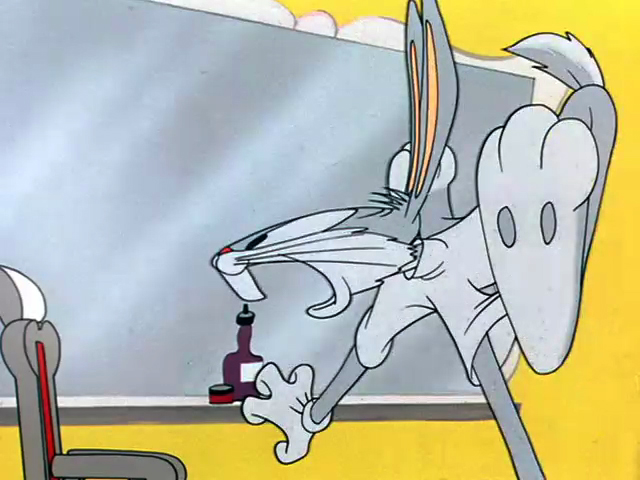
squash and stretch: Squash and stretch is a common animation technique applied to characters or objects in motion.


File:Squash and stretch2.jpg
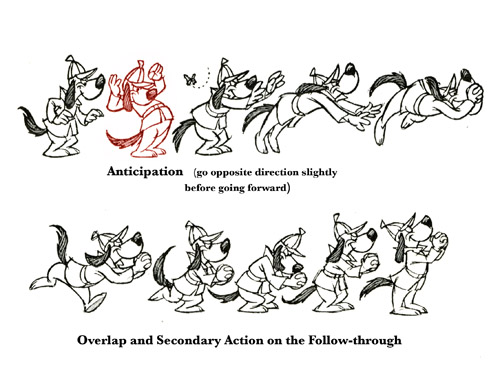
Anticipation:Anticipation is used to prepare the audience for an action, and to make the action appear more realistic
Staging: This principle  to staging  Is purpose is to direct the audience's attention, and make it clear what is of greatest importance.
Straight ahead action and pose to pose: These are two different approaches to the actual drawing process. Straight ahead actionmeans drawing out a scene frame by frame from beginning to end, while pose to pose involves starting with drawing a few, key frames, and then filling in the intervals later
Follow through and overlaping action:These closely related techniques help render movement more realistic, and give the impression that characters follow the laws of physics.


Slow in and Slow out:  The movement of the human body, and most other objects, needs time to accelerate and slow down.
Arcs: Animation should reproduce these movements for greater realism like a limb moving by rotating a joint
Secondary action: Adding secondary actions to the main action gives a scene more life, and can help to support the main action
Timing:Timing refers to the number of drawings or frames for a given action, which translates to the speed of the action on film

Exaggeration: Exageration is very good for animation as it makes the scene beter to whatch.
Soild Drawing: The principle of solid drawing means taking into account forms in three dimensional space, giving them volume and weightThe animator needs to be a skilled


Appeal: Appeal in a cartoon character corresponds to what would be called charisma in an actor

Wednesday, 9 February 2011

Tv animation Walt Disney Television Animation is the animated television production studio of The Walt Disney Compan. It was formed in 1985 as Walt Disney Pictures Television Animation Group, the name was then later changed to Walt Disney Television in the mid1980s then back to its present name in 2003.

Station identification is the practice of radio or television stations or networks identifying themselves on air, typically by means of a call sign or brand name (sometimes known, particularly in the United States, as a "sounder" or "stinger", more generally as a station or network ID). This may be to satisfy requirements of licensing authorities, a form of branding or a combination of both. As such it is closely related to production logos used in television and cinema, alike.

Cinema


Adversitsement  Advertising is a form of communication intended to persuade an audience (viewers, readers or listeners) to purchase or take some action upon products, ideas, or services. It includes the name of a product or service and how that product or service could benefit the consumer, to persuade a target market to purchase or to consume that particular brand. These messages are usually paid for by sponsors and viewed via various media. Advertising can also serve to communicate an idea to a large number of people in an attempt to convince them to take a certain action.

Music videos A music video or song video is a short video or film that accompanies a piece of music or song. Modern music videos are primarily made and used as a marketing device intended to promote the sale of music recordings

Computer games A video game is an electronic game that involves interaction with a user interface to generate visual feedback on a video device. The word video in video game traditionally referred to a raster display device However, with the popular use of the term "video game," it now implies any type of displa device. The electronic systems used to play video games are known as platforms; examples of these are personal computers and video game consoles.

Monday, 17 January 2011

Joseph Plateau (October 14, 1801 – September 15, 1883) was a Belgian physicist. He was the first person to demonstrate the illusion of a moving image. To do this he used counter rotating disks with repeating drawn images in small increments of motion on one and regularly spaced slits in the other. He called this device of 1832 the phenakistoscope
William George Horner (1786 – 22 September 1837) was a British mathematician and schoolmaster. The invention of the zoetrope, in 1834 and under a different name has been attributed to him
Charles Emile Reynaud (8 December 1844–9 January 1918) was a French science teacher, responsible for the first projected animated cartoon films. Reynaud created the Praxinoscope in 1877 and the Theatre Optique in December 1888, and on 28 October 1892 he projected the first animated film in public, Pauvre Pierrot, at the Musee Grevin in Paris. This film is also notable as the first known instance of film perforations being used.
Eadweard J. Muybridge9 April 1830 – 8 May 1904) was an English photographer who spent much of his life in the United States. He is known for his pioneering work on animal locomotion which used multiple cameras to capture motion, and his zoopraxiscope, a device for projecting motion pictures that pre-dated the flexible perforated film strip.
The Kinetoscope is an early motion picture exhibition device. Though not a movie projectorit was designed for films to be viewed individually through the window of a cabinet housing its componentsthe Kinetoscope introduced the basic approach that would become the standard for all cinematic projection before the advent of video
The lumiere brothers were the earlist film makers to date
George Pal  was a Hungarian-born American animar and film producer, principally associated with the science fictin genre. He became an American citizen after emigrating from Europe